
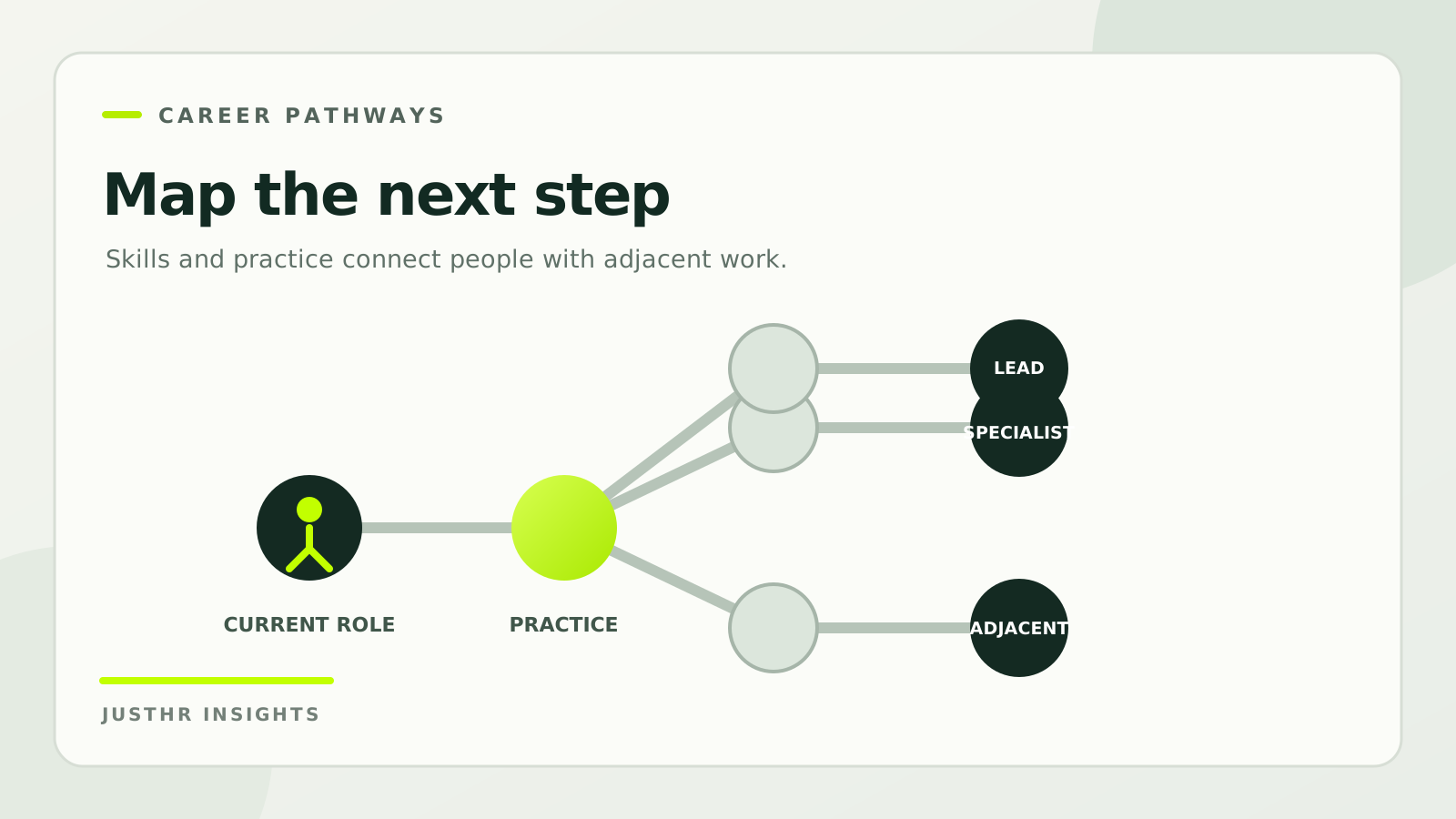

Internal career pathways connect business capability needs with work employees may be ready to take on next. A useful pathway explains the skills, practice and support required; it is not a promise of promotion or a fixed prediction about future jobs.
Start with roles the organisation needs
Choose a small set of roles that are important to the plan and difficult to staff. Describe the work and capabilities involved, then identify positions where employees already practise adjacent skills. Validate the map with managers and employees who understand the work instead of inferring readiness from job titles alone.
Design a pathway with evidence and practice
For each move, document the experience to build, the assignment that can provide practice, the support available and the evidence used to review readiness. Include lateral moves where they build relevant capability. Explain criteria consistently so pathways are transparent without guaranteeing a particular employee an open role.
Pilot, review and keep it current
Test one pathway with a small group and review whether the assignments are available, managers support participation and the assessment is understood. Track applications, moves and feedback in a way that protects privacy. Update the map when the work or business priorities change; do not rely on unsupported forecasts about which jobs will grow.
Describe movement as work, not a ladder
A career path can include a deeper specialist role, a move into management, a cross-functional assignment or a shift to adjacent work. Describe the capabilities and decisions involved in each option rather than implying everyone must climb one hierarchy. This is especially useful in organisations where a small number of management posts cannot absorb every strong contributor.
Use a practical capability map
For a target role, define observable work at increasing levels of scope: what a person handles independently, where they coordinate others and which decisions they can own. Gather examples from current work and ask experienced employees to check that the map reflects reality. Keep criteria understandable to candidates and managers; avoid vague labels such as potential unless they are backed by observable evidence.
Pilot a pathway before publishing it widely
Choose one family of related roles, identify a practice assignment and agree how evidence will be reviewed. Ask participants whether requirements and opportunities are accessible across teams. Look for unintended barriers, including manager reluctance to release talent for a move. Adjust the map after learning from the pilot, and make clear that a pathway supports development but does not guarantee a vacancy or promotion.
Illustrative example
A customer support employee in India wants to move toward quality analysis. Their manager identifies transferable knowledge of recurring customer issues and agrees a small, supervised review assignment. The employee learns how to document patterns, receives feedback and then compares the evidence with the target role's capability map. The example shows one possible bridge; it does not promise a role or imply every employee should take the same route.
Questions for a pathway review
Are the target roles real and needed? Can employees understand the capabilities and evidence required? Who gets access to practice assignments? Do managers have a reason to release people for internal moves? How are decisions reviewed for consistency? Publish the pathway with clear limits, gather employee feedback and check whether the expected opportunities exist. A pathway should describe access and evidence, not guarantee promotion.
Talk to JustHR →