
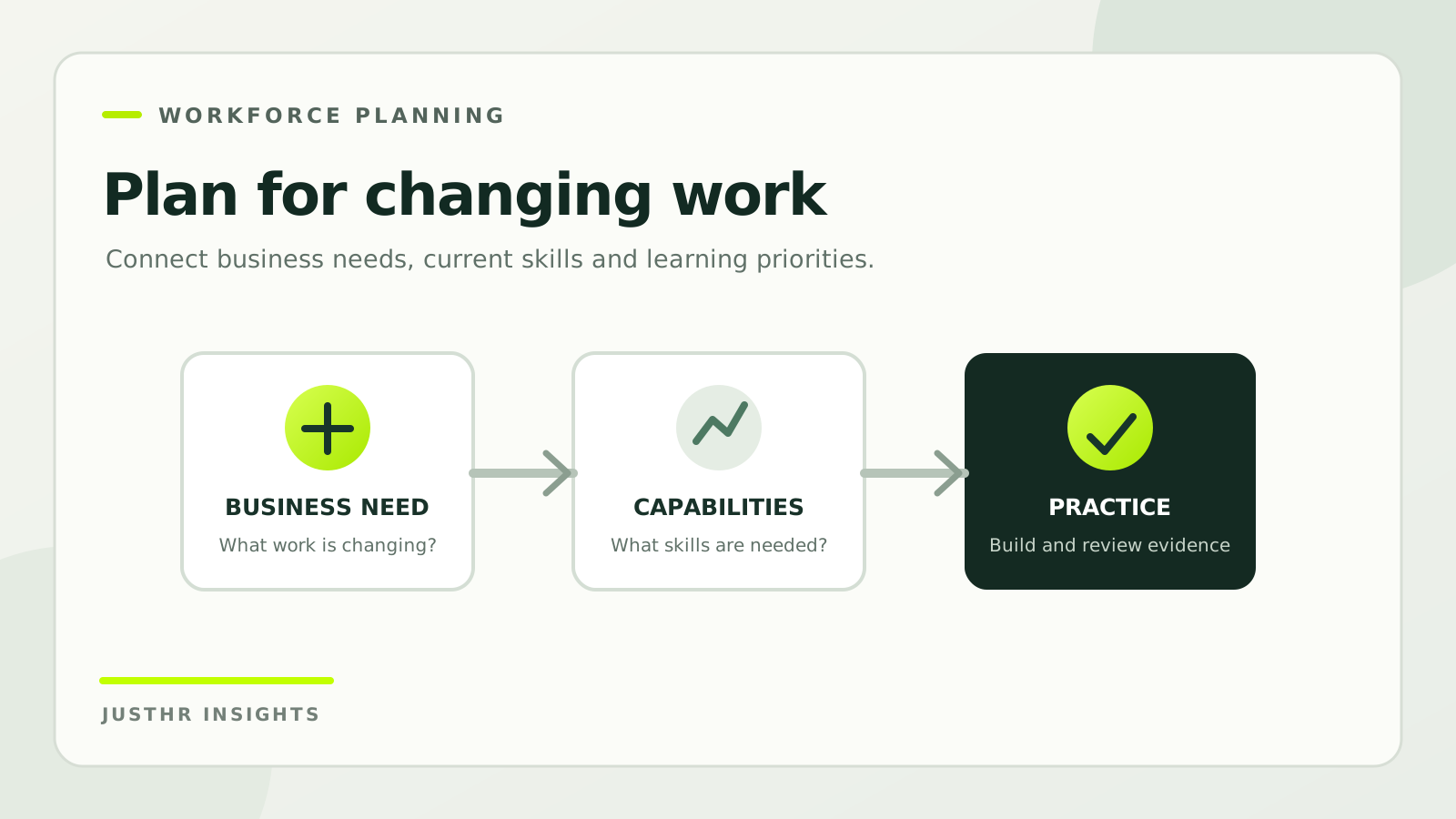

Workforce planning is more useful when it starts with the work the business expects to do, then identifies the capabilities required. For employers, a career pathway is a practical bridge between current skills and future responsibilities—not a prediction that every role will stay unchanged.
Translate strategy into capability questions
Choose a planning horizon that matches upcoming business decisions. Ask which products, customer needs or operating changes may affect work. Describe the capabilities required, then compare them with current strengths. Keep assumptions visible and distinguish commitments from scenarios that may not happen.
Build pathways from adjacent skills
For each gap, identify roles where employees already use related skills. A pathway should show starting experience, skills to add, a practice opportunity and how readiness will be assessed. Include lateral moves as well as promotions; explain the work and support involved rather than promising a title.
Test the plan through real work
Pilot one pathway, give participants scoped assignments and ask managers to review evidence. Track whether learning transfers into performance and whether the receiving team can support the move. Refresh plans when business priorities or role requirements change; a skills list is not a permanent forecast.
Start from work that is changing
Managers can identify the tasks that are growing, shrinking or being redesigned before trying to predict exact future job titles. Ask where technology, customer expectations or new operating models are changing daily work. Map the capabilities required for those tasks and the people who already demonstrate adjacent strengths. This gives a workforce plan a useful starting point while acknowledging that long-range forecasts are uncertain.
Use projects to test learning
A course can introduce a concept, but applied work shows whether someone can use it. Pair learning with a contained assignment, a manager check-in and feedback from a colleague who understands the task. Make the expected evidence explicit, such as a better handover, an analysis or a safe demonstration of a new process. Do not promise promotion solely for completing training; connect opportunity to demonstrated capability and business need.
Keep pathways open to different starting points
Employees may reach the same capability through different experience, training or project work. Publish what good evidence looks like and how people can access practice, while preserving role requirements and fair selection. Review who gets stretch assignments and who is overlooked. A pathway is credible when managers can explain both the opportunity and the evidence needed to progress.
Illustrative example
An Indian services team expects more work to involve analysing operational data. Its managers identify current employees who understand the process and select a contained assignment where they can practise basic analysis with feedback. The team reviews the resulting work before deciding what formal training or hiring it still needs. This illustrative sequence connects changing work to capability building without promising that a particular course guarantees a future role.
Questions for a capability plan
Which work is changing and what evidence supports that view? What capabilities are already present? Which skills can be built through practice, and which require a new hire or specialist? Who gets access to development opportunities? How will managers check whether learning transfers to the job? Revisit the answers as business priorities shift; a future-skills plan should be updated rather than treated as a fixed forecast.
Talk to JustHR →