
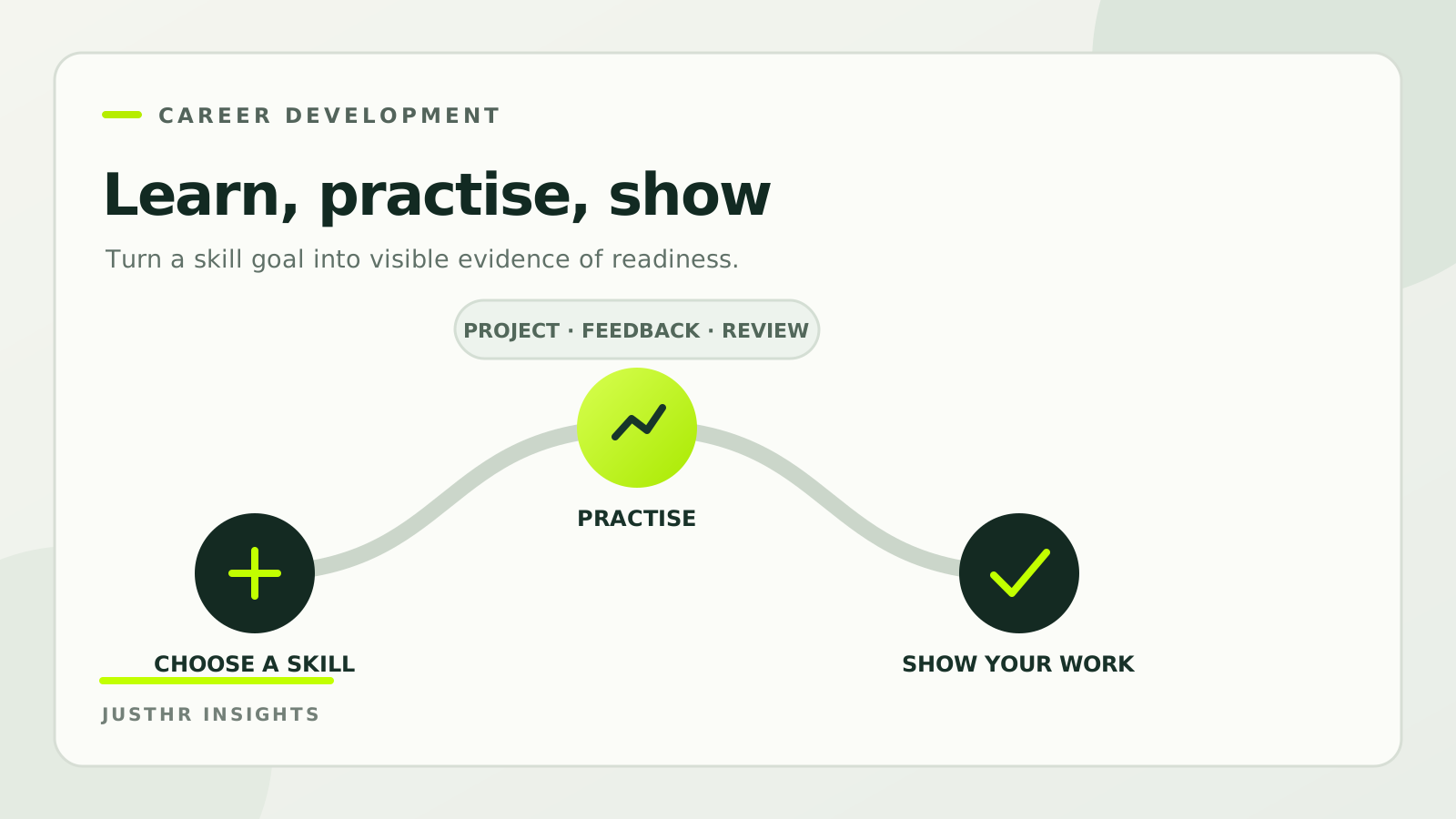
Career development is easier to act on when tied to a role you can describe. Rather than predicting every future job, identify the work you want next, strengths you already bring and evidence you still need to build.
Choose a direction before a course
Collect role descriptions that genuinely interest you and note recurring responsibilities. Compare them with your projects, tools and strengths. A course is useful when it closes a specific gap or gives practice; a certificate without application may not show readiness.
Build proof through applied work
Use a project, stretch assignment or work sample to demonstrate the capability. Describe the problem, your approach and the outcome while respecting confidentiality. Ask someone who performs the target work to review the evidence and identify what remains missing.
Create a pathway with review points
Set a learning goal, practice opportunity and date to review progress. Consider lateral roles as well as promotions. Update your CV and profile when you have credible new evidence, and revisit the plan when your interests or the work itself changes.
Translate a target role into learnable skills
Read current role descriptions and speak with people doing the work to identify recurring tasks, tools and decisions. Separate fundamentals from the specialised knowledge that can be learned later. Compare those requirements with your existing experience, including projects, customer work and responsibilities that may transfer. This gives you a focused learning question instead of an endless list of courses.
Turn study into visible evidence
Choose a project, portfolio piece or responsibility that demonstrates the capability you are learning. Define what a reviewer should be able to see and ask for feedback from someone familiar with the work. Use public or synthetic material when real employer information is confidential. Explain your contribution and limitations honestly; a small completed example is more useful than claiming broad proficiency without proof.
Use conversations to test the pathway
Ask practitioners what beginners misunderstand, what evidence they look for and which entry routes are realistic. Keep questions specific and respect their time. Compare several perspectives because one person's career history is not a universal route. Revisit the plan after trying a project or application, then adjust based on what you learn rather than treating a career choice as irreversible.
Illustrative example
A customer operations professional wants to move into business analysis. They speak with two practitioners, identify a skill gap in translating questions into structured analysis and build a small project using non-confidential sample data. A reviewer comments on the assumptions and clarity before the candidate updates their CV. The project does not guarantee a role, but it gives the person and employer something concrete to discuss.
Questions for your learning plan
What target role are you testing? Which requirements appear across several current vacancies? What evidence do you already have? Can you practise the missing skill through a project or responsibility? Who can give informed feedback? How will you know whether the path remains attractive? Review the plan after taking action and adjust it to current opportunities rather than buying courses without a target.
Talk to JustHR →